

Houston sits where I-10 and I-45 cross—two of the most critical freight corridors in the country. I-10 runs coast to coast. I-45 connects Dallas to Galveston through the heart of Texas. Port Houston handles 4.03 million TEUs annually, making it the fifth largest container port in the US.
If you’re running distribution operations, managing wholesale inventory, or coordinating logistics across the Southwest, Houston’s infrastructure creates advantages that other metros don’t match.
The challenge: finding warehouse space that fits small to mid-sized distribution needs. Most available inventory targets 50,000+ SF tenants. Spaces under 2,000 SF with proper loading infrastructure require knowing where to look.
Why Houston Works for Distribution and Logistics
Highway Intersection Advantage
I-10 carries freight coast-to-coast from Los Angeles to Jacksonville. I-45 runs north-south from Dallas to Galveston. Beltway 8 circles the metro, connecting all major radial highways.
From Northwest Houston, you reach:
- Dallas-Fort Worth: 3.5-4 hours
- San Antonio: 3 hours
- New Orleans: 5 hours
- Austin: 2.5 hours
For regional distribution covering Texas and the Southwest, Houston positioning reduces average delivery distances compared to locations at the edge of your territory.
Port Houston Access
Port Houston handled 4.03 million TEUs in 2024—up year over year. The port ranks as the largest container port on the Gulf Coast and the fifth largest in the US.
If you’re importing products from Asia, Latin America, or Europe, Houston offers direct access without routing through congested West Coast ports. Container-to-warehouse time drops significantly when your warehouse sits within an hour of the port.
Carrier Hub Density
Houston concentrates fulfillment and carrier infrastructure:
- Amazon: HOU7, IAH4, HTX1/HTX2, and the 800,000 SF HOU9 sortation center in Katy
- FedEx Ground Houston Hub: Largest FedEx Ground facility in Texas
- UPS Willowbrook: 300 trucks, three-day ground coverage to the entire continental US
- USPS Regional Distribution: Major facility serving Southeast Texas
For distribution operations with daily carrier pickups, proximity to these hubs means later cutoff times and faster transit.
Labor Pool
Houston metro has 7.9 million people. If you’re hiring warehouse workers, pickers, and drivers, the labor pool exists. Construction and logistics employment remains strong—237,100 construction workers alone as of late 2024.
What Houston Distribution Businesses Need in Warehouse Space
Loading Dock Configuration
The number, type, and positioning of loading docks directly impact efficiency.
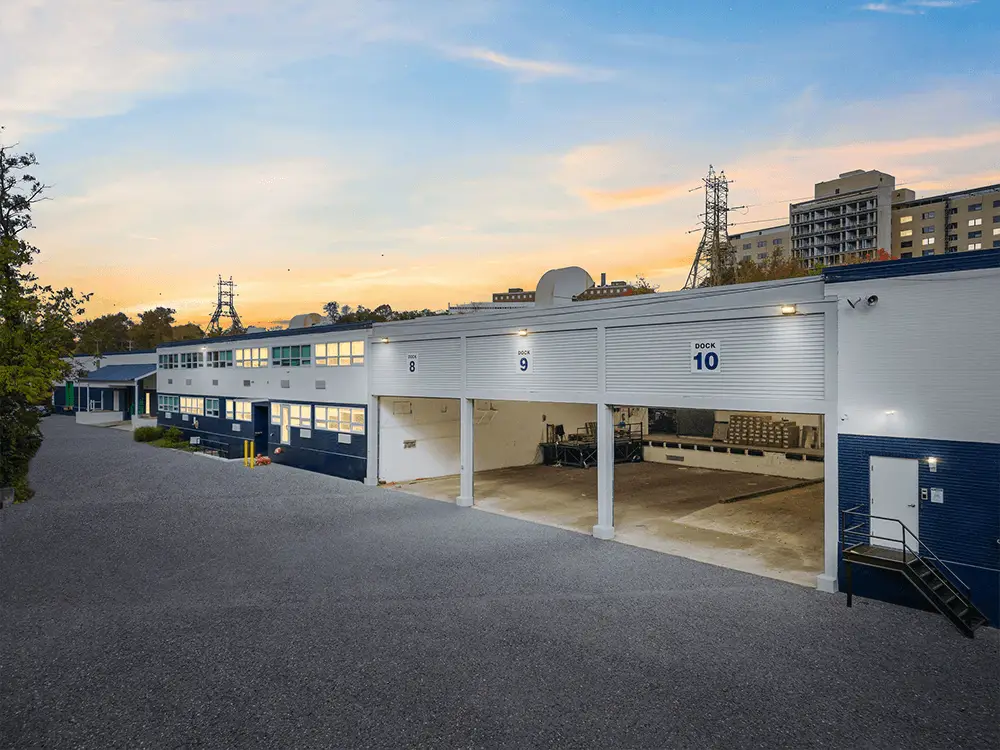
Dock-high doors allow direct truck-to-warehouse transfer without ramps. Pallets move from trailer to racking in minutes instead of hand-carrying through ground-level doors.
Drive-in doors work for operations using box trucks and sprinter vans. Less efficient for full pallet loads.
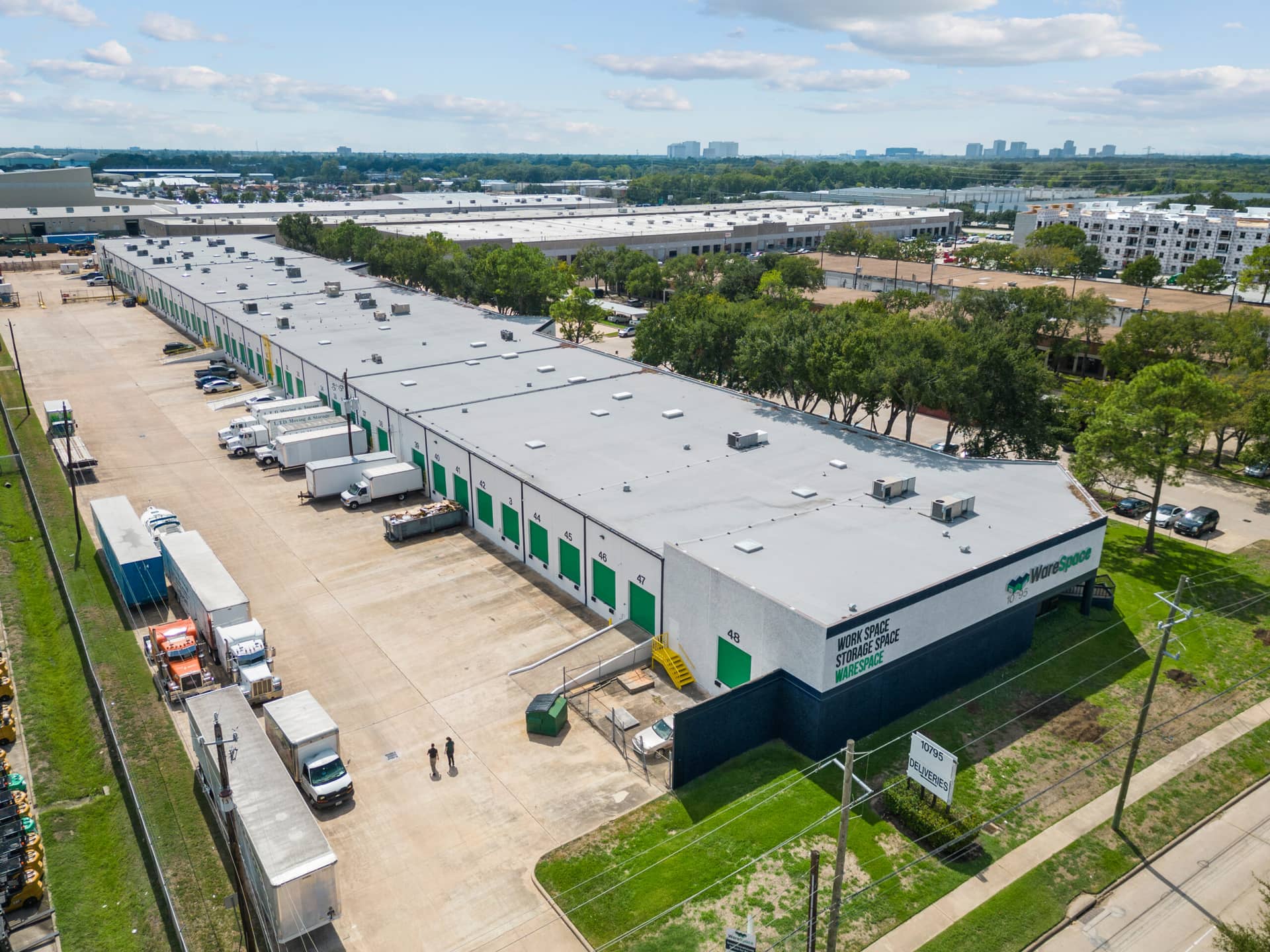
Giovanni Romero receives furniture for interior design clients on 18-wheelers at WareSpace Houston. Dock access means a pallet jack moves pieces from the trailer to storage efficiently. Without docks, he’d need liftgate trucks and crew to hand-carry furniture.
Clear Height for Racking
Distribution efficiency depends on vertical storage. Standard 10-12 foot ceilings limit you to single-level pallet storage.
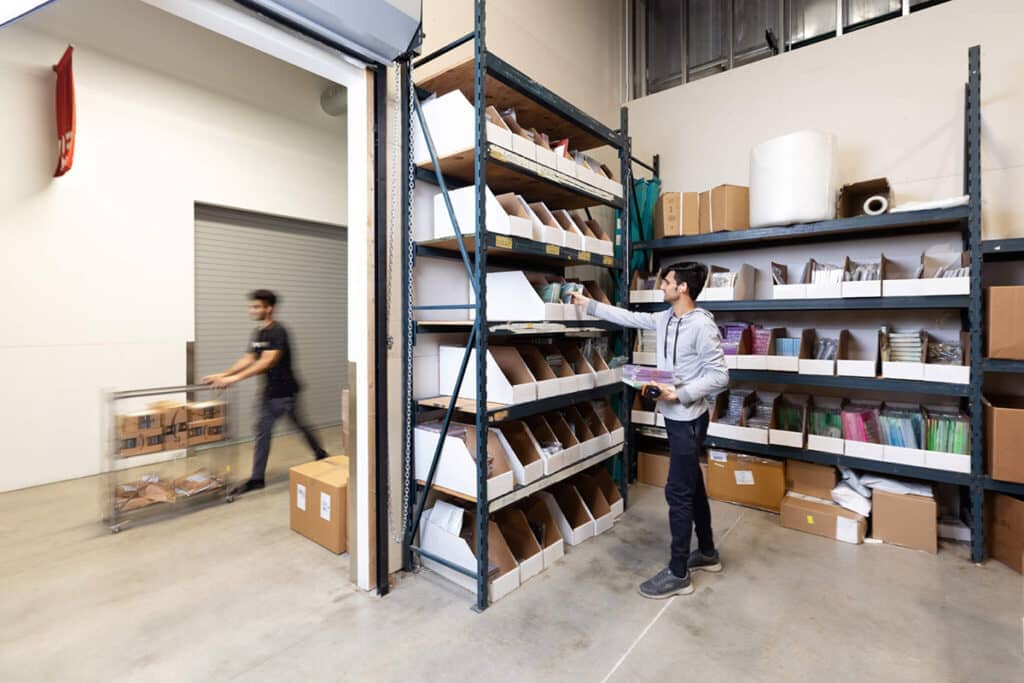
Look for 14-16 foot minimum clear height to allow multi-level racking. WareSpace Houston units feature 16+ foot ceilings with industrial racking included.
Climate Control for Product Protection
Houston’s climate affects inventory:
- 75% average humidity year-round
- 99 days above 90°F annually
- Temperature swings between seasons
Definitely need climate control:
- Electronics and components
- Supplements and pharmaceuticals
- Food products (non-refrigerated)
- Paper goods and packaging
- Cosmetics and personal care
Usually fine without:
- Hardware and industrial supplies
- Automotive parts (non-fluid)
- Building materials
- Non-perishable consumer goods
Carrier Proximity
Daily pickups from multiple carriers require reasonable proximity to their hubs. Being 45+ minutes from carrier facilities means earlier cutoff times, limited pickup windows, and potential surcharges.
Northwest Houston puts you within 15-20 minutes of FedEx Ground’s hub, UPS Willowbrook, and Amazon’s sortation centers.
Space That Scales
Distribution needs fluctuate with:
- Seasonal inventory swings (Q4 retail, back-to-school)
- Customer growth requires additional inventory
- Product line expansion
- Market conditions affecting stock levels
Traditional 3-5 year leases lock you into fixed square footage. Flexible terms let you adjust without paying for unused space or scrambling for additional capacity.
Where to Find Distribution Warehouse Space in Houston
Northwest Houston (Beltway 8/I-10/US-290)
Best for: Regional distribution prioritizing carrier hub access and highway connectivity
The densest concentration of fulfillment infrastructure in Houston. Minutes from FedEx Ground, UPS Willowbrook, and Amazon facilities. Highway access to all parts of the metro and beyond.
WareSpace Houston at 10795 Hammerly Boulevard sits in this corridor with 200-2,000 SF units, loading dock access, and all-inclusive pricing.
Rates: Approximately $0.93/SF monthly for flex space.
Southeast Houston / Port Area
Best for: Importers and exporters moving containers through Port Houston
Closest proximity to port facilities. Lower rents than in Northwest Houston. Older building stock with fewer modern small-bay options.
Drive times to Northwest Houston carrier hubs run 45-60 minutes. If your distribution model relies heavily on port access and less on daily carrier pickups, Southeast makes sense.
Rates: Lowest in Houston—approximately $0.70-0.85/SF monthly.
North Houston / Airport Area
Best for: Distribution operations using air freight
Proximity to George Bush Intercontinental Airport for time-sensitive shipments. Good ground carrier access via I-45 and Beltway 8.
Rates: Similar to Northwest Houston.
Southwest Houston
Best for: Distribution serving the West Houston customer base
Higher rents at approximately $1.00/SF monthly. Less logistics infrastructure. Makes sense only if your customer concentration justifies the premium.
What Distribution Warehouse Space Costs in Houston
Traditional Lease (1,500 SF)
- Base rent: $9/SF annually = $1,125/month
- NNN/CAM charges: $4/SF = $500/month
- Utilities: $250-400/month (climate-controlled)
- Equipment (racking, material handling): $4,000-8,000 upfront
- Security deposit: 1-2 months rent
- Monthly total: $1,875-2,025
- Upfront costs: $6,000-12,000
- Lease term: 3-5 years with personal guarantee
Co-Warehousing (Large unit at WareSpace Houston)
- All-inclusive rate: $2,100/month
- Security deposit: $2,100
- Equipment: included (racking, shared pallet jacks)
- Monthly total: $2,100
- Upfront costs: $2,100
- Lease term: 6 months, flexible
Traditional lease costs less monthly for established operations confident about 3+ year needs. Co-warehousing requires $2,100 to move in vs. $8,000-14,000 and provides flexibility to scale.
Traditional Lease vs. Co-Warehousing for Houston Distribution
Go Traditional If:
Predictable long-term space needs. You’ve been in business 5+ years, maintain consistent inventory levels, and can confidently project requirements for 3-5 years.
You want maximum customization. Traditional leases allow permanent installations, custom racking configurations, and modifications without landlord restrictions.
Significant specialized infrastructure is needed. Heavy-duty racking, specialized equipment, or unique facility modifications require long-term occupancy to justify investment.
Go Co-Warehousing If:
Growing with uncertain space needs. Revenue climbing, product lines expanding, testing new markets. Flexible terms let you adjust capacity without lease penalties.
Need immediate occupancy. Traditional leases take weeks to months from search to move-in. Co-warehousing spaces can be ready in days.
Value operational simplicity. One monthly payment covers everything. No utility bills, maintenance coordination, or facility management overhead. Focus stays on distribution operations.
Capital-constrained. Avoiding $5,000-10,000 upfront equipment costs preserves capital for inventory and growth.
Common Houston Distribution Warehouse Mistakes
- Choosing a location based only on rent. Southeast Houston has the lowest rents. If your distribution requires daily carrier pickups and those carriers hub in Northwest Houston, the 45-minute drive each direction costs more than the rent savings.
- Inadequate loading infrastructure. A great space with one shared dock and ten tenants competing for access creates daily bottlenecks. Verify dock availability matches your operational needs.
- Ignoring ceiling height. 12-foot ceilings limit you to single-level pallet storage. You’re paying for floor space you can’t stack.
- Signing long-term leases during growth. Locking into 5-year leases when volume is climbing rapidly results in either paying for unused space or scrambling for additional capacity mid-lease.
Houston Distribution Warehouse FAQs
What size warehouse do small distribution businesses need?
Varies by inventory levels and product types:
- Startup/small operations: 400-1,000 SF
- Established small distributors: 1,000-2,000 SF
- Growing regional operations: 2,000-5,000+ SF
Plan 30-40% more than the current inventory requires to accommodate seasonal peaks and growth.
Do I need climate control for distribution warehouse space in Houston?
Depends on product mix. Electronics, supplements, cosmetics, and food products typically require climate control. Automotive parts, hardware, and industrial supplies usually don’t. Houston’s 75% humidity and extreme summer heat make climate control more important here than in drier climates.
How important is Port Houston’s proximity for distribution?
Critical if you’re importing containers directly. Less critical if your supply chain brings product via ground freight from domestic suppliers. Even for importers, carrier hub proximity often matters more for outbound distribution than port proximity for inbound.
What’s the minimum lease term for distribution warehouse space?
Traditional industrial leases: 3-5 years. Co-warehousing: 6-month terms at WareSpace Houston. For distribution operations with fluctuating inventory, shorter terms reduce risk.
Can I run a small 3PL from shared warehouse space?
Yes. Many 3PL operations start in spaces under 2,000 SF serving multiple small clients. Requirements: adequate internet for WMS systems, sufficient loading access for daily carrier pickups, and proper layout for receiving, storage, and packing zones.
WareSpace Houston offers distribution warehouse space from 200-2,000 sq ft at 10795 Hammerly Boulevard. Climate-controlled units, loading docks, 16+ foot ceilings, industrial racking included, all-inclusive pricing starting at $650/month, 6-month flexible leases. Book a tour to see available units.
 ►
Explore 3D Space
►
Explore 3D Space