
Your truck is full of equipment that should be organized in a shop. Your garage has turned into an unofficial warehouse that is making your HOA send letters. Your inventory is scattered across storage units in three different suburbs, and you are losing hours every week driving between them.
You need actual warehouse space, but everything you find is either 10,000+ square feet (way more than you need) or a storage unit with no power, no loading access, and rules that prohibit running a business.
Chicago has options for small businesses that need real warehouse space between 200 and 2,000 square feet. Here is how to find it, what it costs, and whether the western suburbs or northern suburbs make more sense for your operation.
Chicago small warehouse at a glance
- WareSpace locations
- Downers Grove & Wheeling
- Unit sizes
- 200–2,000 Sq Ft
- Lease terms
- Short-term, 6 to 12 months
- All-inclusive rate
- Starting at $1,000/mo
- Included
- Loading docks, HVAC, racking, WiFi
Who Actually Uses Small Warehouse Space in Chicago
Small warehouse space works for any business that needs more than a garage but less than an entire industrial building.
Contractors and Trades
Electricians, plumbers, HVAC techs, general contractors, and specialty trades need space for tools, equipment, materials, and vehicle parking. Chicago-area construction employs over 192,000 workers, and most of that work comes from businesses running out of trucks, garages, and inadequate storage units. Professional shop space means organized tools, secure equipment storage, and a place to prep jobs before heading to sites. Our Chicago contractor shop space guide covers sizing and trade-specific needs. Typical space: 300 to 800 Sq Ft for solo operations, 800 to 1,500 Sq Ft for crews of three to five people.
eCommerce and Online Sellers
Shopify stores, Amazon sellers, and DTC brands shipping orders from inventory they control. Illinois hosts approximately 15,000+ Amazon independent seller partners, many running Fulfillment by Merchant operations. The spare bedroom worked at 20 orders a week; it breaks at 200. Typical space: 200 to 400 Sq Ft for under 100 weekly orders, 400 to 800 Sq Ft for 100 to 300 orders, 800 to 1,500 Sq Ft for 300 to 500 orders. Our Chicago eCommerce fulfillment guide covers sizing and carrier proximity in depth.
Distribution and Wholesale
Businesses receiving products from manufacturers and distributing to customers, retail locations, or B2B accounts. Alessia Serafino needed warehouse space to get her Illinois liquor distribution license. Traditional office spaces kept refusing her because landlords did not want to deal with alcohol storage. She found WareSpace Chicago, where loading docks handle her 80-case pallets arriving on semi-trucks, with plans to scale to truck deliveries as her territory expands throughout Chicagoland. Typical space: 400 to 1,000 Sq Ft for small distribution, 1,000 to 2,000 Sq Ft for established regional operations.
Service Businesses with Equipment
Mobile service businesses, event companies, equipment rental, landscaping, and cleaning services that operate in the field but need a base. Chaka Howard ran an events marketing company with 200+ brand ambassadors out of her living room, with promotional materials in three storage units and ambassadors picking up equipment from her driveway. The setup was becoming unsafe. A real space gave her a secure base and somewhere professional to meet clients. Our Chicago service business storage guide goes deeper on conference rooms and equipment storage. Typical space: 300 to 600 Sq Ft for small mobile operations, 600 to 1,500 Sq Ft for larger operations.
Creative and Production Studios
Photography studios, video production, content creation, podcasting, and maker spaces. John Kelly ran JKM Photography out of his living room, rearranging furniture for every shoot. A dedicated studio meant a permanent setup, more services, and his home back. He has since been hired by several companies in his building through hallway conversations. Typical space: 400 to 1,000 Sq Ft depending on production type.
What You Want Included in Chicago Warehouse Space
Size Flexibility
Your space needs change as your business grows. Alessia started with a small unit to meet state licensing requirements, and as her distribution territory expands she can scale to larger units without relocating operations. Look for terms that let you size up or down with 30 to 60 days’ notice without penalties.
Loading Dock Access
If you are receiving pallets or moving heavy equipment, loading dock access is non-negotiable. Alessia’s spirits arrive on semi-trucks carrying 80-case pallets; a pallet jack moves cases from trailer to storage in minutes instead of hand-carrying hundreds of cases through standard doors.
Climate Control
Chicago weather swings from -10 degree winters to 90 degree summers with humidity. Temperature fluctuations stress inventory, warp materials, and damage electronics. If you store anything you would keep climate-controlled at home (electronics, products for resale, chemicals, wood materials), climate-controlled space makes sense. See our Chicago climate considerations for product-specific guidance.
Power, Security, and Parking
Most small warehouse spaces include basic 120V electrical; verify capacity before signing if you run 220V equipment. For security, look for 24/7 access control, cameras in common areas, individual unit locks, well-lit parking, and on-site management. Alessia’s security cameras proved valuable when a trucking company claimed a delivery attempt that never happened; the on-site manager reviewed footage and helped her avoid redelivery fees. And if you run work vehicles or trailers, confirm parking counts and truck access up front.
Chicago Suburbs for Small Warehouse Space
For a full side-by-side of taxes, drive times, and submarkets, see our Downers Grove vs. Wheeling neighborhood guide.
Western Suburbs: Downers Grove (DuPage County)
Best for businesses serving the entire metro and operations wanting lower property taxes. WareSpace Downers Grove sits at 5200 Thatcher Road, directly along I-355 with I-88 access nearby. Downtown Chicago is 30 minutes away and O’Hare is 25 to 30 minutes. DuPage County’s effective commercial tax rates run roughly half those of suburban Cook County, which translates to lower NNN charges in traditional leases.
Northern Suburbs: Wheeling (Cook County)
Best for businesses prioritizing O’Hare proximity, manufacturing, or air-freight needs. WareSpace Wheeling at 301 West Hintz Road sits in an established industrial park with I-294 and IL-53 access, and O’Hare is just 20 minutes away. Wheeling ranks as Illinois’ fifth largest manufacturing concentration with nearly 14 million Sq Ft of industrial space. Cook County’s higher property taxes can be offset by the Class 6B Industrial Tax Incentive for qualifying industrial properties.
How to Choose
Choose Downers Grove if your customers and job sites spread across the entire metro, lower operating costs matter more than O’Hare proximity, or property tax savings influence your decision. Choose Wheeling if air freight or O’Hare access is critical, you are in or serve manufacturing, or proximity to the northern suburbs matters.
What Small Warehouse Space Costs in Chicago
WareSpace Chicago uses all-inclusive pricing, one flat monthly rate covering rent, taxes, insurance, CAM, utilities, climate control, loading docks, racking, WiFi, and shared amenities:
- 200 to 400 Sq Ft: starting at $1,000/mo all-inclusive
- 500 to 800 Sq Ft: from $1,400/mo all-inclusive
- 900 to 1,400 Sq Ft: from $1,900/mo all-inclusive
- 1,500 to 2,000 Sq Ft: from $2,400/mo all-inclusive
Traditional leases look cheaper on the base rate, but you add 30 to 50% for NNN/CAM charges, utilities (Chicago winters mean real heating costs), upfront equipment ($2,000 to $5,000), and 3 to 5 year commitments with personal guarantees. For the full breakdown, see our Chicago warehouse cost guide or compare options on our pricing page.
Traditional Lease vs. Co-Warehousing in Chicago
Go with a traditional warehouse lease if you are confident about your space needs for 3+ years, operating on minimal margin, comfortable managing facilities yourself, and already own your equipment.
Go with co-warehousing if you are growing and your space needs are changing, seasonal, avoiding upfront capital costs, leasing commercial space for the first time, or you need a professional setup ready the day you move in.
Finding Small Warehouse Space for Rent in Chicago
Traditional brokers focus on spaces over 5,000 square feet. For 200 to 2,000 Sq Ft, target co-warehousing and flex-space providers, small-bay industrial buildings (often owner-managed, listed on LoopNet or Crexi), and direct owner listings on Craigslist or Facebook Marketplace. Many small spaces never get listed online, so it pays to drive the industrial areas in Elk Grove Village, Bensenville, and Addison in the northwest, or Carol Stream and Glendale Heights in the west.
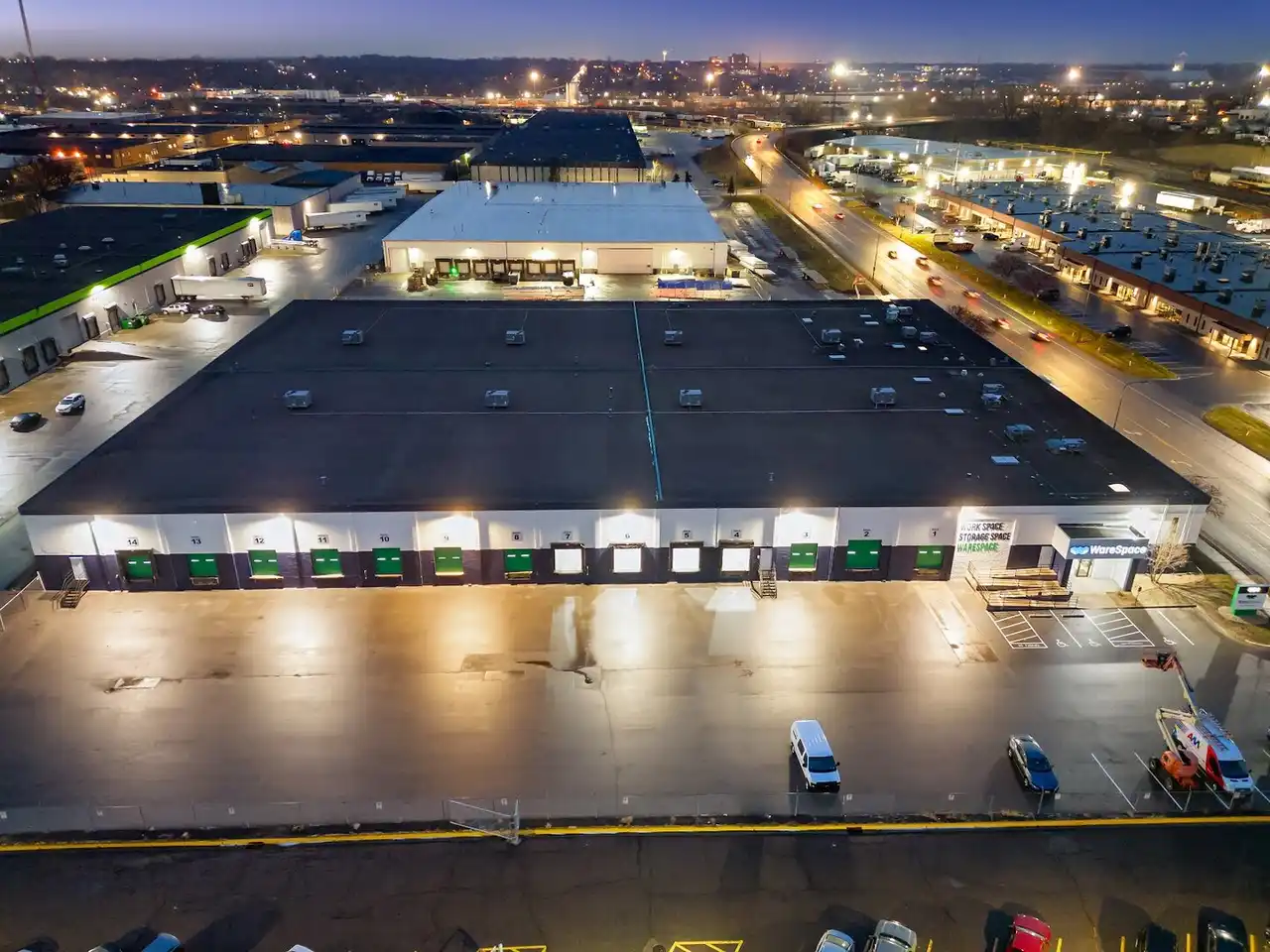
WareSpace Chicago has leasing buildings in Downers Grove and Wheeling, plus Downers Grove North at 1400 Centre Circle coming soon. WareSpace offers 200 to 2,000+ Sq Ft units with all-inclusive pricing and short-term 6-12 month leases. Loading docks, HVAC, equipment, WiFi, conference rooms, kitchen, and 24/7 access are standard WareSpace features. Book a tour of a leasing building or review current conditions in the Chicago industrial market report.
Small Warehouse Space FAQs for Chicago
What is the smallest warehouse space I can rent in Chicago? Most traditional warehouse spaces start at a 5,000 to 10,000 Sq Ft minimum. Co-warehousing facilities like WareSpace offer units as small as 200 Sq Ft for solo contractors, small eCommerce operations, or businesses moving out of a home.
Which is cheaper, DuPage County or Cook County? DuPage County (Downers Grove area) typically runs lower total occupancy cost due to significantly lower property taxes, though Cook County’s Class 6B incentive can narrow the gap for qualifying industrial users.
Can I run a business from a Chicago storage unit? No. Self-storage facilities prohibit business operations under their lease terms. You cannot work on-site, receive business deliveries, or meet clients.
What is included in Chicago warehouse rent? Traditional leases usually cover just the space; you pay separately for utilities, NNN, CAM, internet, and equipment. All-inclusive co-warehousing bundles climate control, utilities, WiFi, loading docks, equipment, shared amenities, and maintenance into one rate.
What happens if I outgrow my Chicago warehouse space? With a traditional lease you are locked in for the term. With co-warehousing you size up to a larger unit in the same facility with 30 to 60 days’ notice, the way Alessia scales as her territory grows.
Ready to get out of the garage? Get an instant quote or book a tour of WareSpace Chicago.


