

Your garage stopped being a garage two years ago. Now it’s a staging area for equipment, inventory, and supplies that keeps expanding into the house. Your spouse has stopped asking when you’ll clear it out. Your neighbors have started noticing the delivery trucks.
Or maybe you’re paying for three storage units scattered across different facilities, driving between them whenever you need something, and wondering why running your own business requires this much logistics overhead before you even start the actual work.
Philadelphia has nearly 30,000 small businesses, and the traditional commercial real estate market doesn’t have much for you. Self-storage gives you space without the infrastructure to actually work.
The missing middle—200 to 2,000 square feet of real warehouse space with loading docks, climate control, and flexible terms—is what growing Philadelphia businesses actually need.
Who Uses Small Warehouse Space in Philadelphia
Contractors and Trades
Philadelphia’s aging housing stock generates constant renovation work. Victorian row homes from the 1890s. Red brick twins from the 1920s. Post-war construction from the ’50s. These buildings need electrical upgrades, plumbing replacement, HVAC retrofits, and structural repairs.
The contractors doing this work accumulate equipment. Trucks fill up. Garages overflow. Storage units don’t allow you to actually work, and most landlords won’t rent 600 square feet of industrial space to a small contractor.
Eduardo Ramos ran his floor restoration business out of four separate storage units. Grinders in one unit, chemicals in another, polishers in a third. He drove between them constantly, wasting hours on logistics. When thieves broke in, the basic security didn’t protect his equipment. Moving to consolidated warehouse space with proper security and climate control transformed his operation.
What contractors need:
- 24/7 access for early morning job starts and late material drops
- Climate control for temperature-sensitive chemicals and materials
- Loading access for heavy equipment
- Security that actually protects your investment
- Space to prep, stage, and maintain equipment—not just store it
Typical space: 300-800 SF for solo operators, 800-1,500 SF for small crews
E-commerce and Fulfillment
Philadelphia sits at the center of the Northeast Corridor. Ship from here and you reach roughly 100 million consumers within a single day’s drive—New York, Boston, Washington DC, Baltimore, and everything between.
The logistics infrastructure supporting this position has grown substantially:
- Port of Philadelphia: The Port of Philadelphia recently attracted Maersk and Hapag-Lloyd to relocate trans-Atlantic shipping routes here. It boasts the fastest arrival-to-departure time of any North American port, according to World Bank data.
- Amazon density: Amazon operates 50+ facilities in the Greater Philadelphia region, including a new 140,000 SF last-mile distribution center in Southwest Philadelphia.
- Carrier infrastructure: FedEx and UPS maintain major regional hubs. This density means later pickup cutoffs, competitive rates, and reliable transit times.
For e-commerce sellers, this carrier infrastructure means orders processed late in the day still ship same-day. Products reach NYC, DC, and Boston in 1-2 days via ground—no air freight premium required.
What e-commerce sellers need:
- Receiving infrastructure for inbound inventory (loading docks for pallets)
- Daily carrier pickups (FedEx, UPS, USPS)
- Climate control for temperature-sensitive products
- Organization systems (racking, picking zones, staging areas)
- Space that scales with seasonal demand
Typical space: 400-800 SF for moderate volume, 800-1,500+ SF for higher throughput
Service Businesses with Equipment
Event companies, cleaning services, mobile detailing, equipment rental, and catering operations—these businesses operate in the field but need a home base. Inventory, supplies, staging space, and a professional location for client meetings.
The home-based setup that worked when you started becomes a problem as you grow. Brand ambassadors picking up supplies from your driveway. Equipment is scattered across storage units. Family members navigate around work materials. And the question of whether your current setup projects the image your growing business deserves.
Chaka Howard runs Indigo Events, coordinating 200+ brand ambassadors for promotional events. She was meeting clients at her dining room table and having strangers pick up promotional materials from her driveway. The safety concerns alone justified moving to a dedicated space—but the conference rooms for client meetings and a professional environment elevated how her business was perceived.
What service businesses need:
- Secure equipment storage with controlled access
- Staging and prep areas for event and job preparation
- Professional meeting space for clients
- Flexible access hours (events happen evenings and weekends)
- Climate control to protect materials and equipment
Typical space: 200-600 SF for equipment-focused operations, 600-1,200 SF with staging areas
Creative and Production Businesses
Photography studios, woodworking shops, fabrication businesses, screen printing operations, small-batch manufacturers—these businesses need room to make things, not just store them.
John Kelly was shooting professional photos in his living room, rearranging furniture between sessions. The lack of a dedicated space limited what he could produce and how clients perceived his business. After relocating to dedicated space, he landed eight new clients just from hallway conversations with other tenants—a networking benefit he hadn’t anticipated.
What creative businesses need:
- Work space with adequate ceiling height and natural light
- Electrical service sufficient for equipment
- Loading access for materials and finished products
- Clean, climate-controlled environment
- Separation of work and living space
Typical space: 400-1,000 SF depending on production requirements
Light Manufacturing and Assembly
Small-batch production, kitting operations, product assembly, packaging—manufacturing scaled for small business rather than industrial production lines.
Philadelphia’s manufacturing history left behind buildings and infrastructure suited for production. While heavy manufacturing has largely moved elsewhere, light manufacturing and assembly operations thrive in appropriately-sized spaces.
What light manufacturers need:
- Power capacity for equipment
- Ventilation for processes that generate fumes or particles
- Loading access for raw materials and finished goods
- Organization space for inventory and work-in-progress
- Compliance with any applicable regulations
Typical space: 600-2,000 SF depending on production scale
What to Look for in Philadelphia Small Warehouse Space
Loading Infrastructure
If your business involves moving anything larger than what fits in a car trunk, loading access matters. There are two main types:
Dock-high loading: Elevated platforms that align with truck beds. Essential for receiving pallets, handling freight deliveries, and loading larger shipments. Most efficient for high-volume operations.
Drive-in access: Ground-level doors that vehicles can back up to. Works for vans, box trucks, and hand-loading operations. More flexible for varied vehicle types.
Traditional small warehouse leases often skip this infrastructure or charge extra for shared dock access. Verify what’s included before committing.
Climate Control
Philadelphia’s weather demands year-round climate management:
- Summer: High humidity and temperatures pushing into the 90s damage electronics, warp materials, degrade adhesives, and accelerate product expiration.
- Winter: Freezing temperatures crack liquids, damage batteries, and make certain materials unusable.
Products, chemicals, electronics, and temperature-sensitive materials need protection. Basic storage units typically offer no climate control. Traditional warehouse space may include heating without cooling. All-inclusive facilities like WareSpace include year-round HVAC as standard—no surprise utility bills when you run the AC in August.
Flexible Lease Terms
Traditional industrial leases run 3-5 years with personal guarantees. That structure works for established businesses with predictable space needs. It creates problems for growing businesses facing uncertainty:
- What if you need more space in 18 months?
- What if a major client disappears?
- What if you’re personally liable for $50,000+ in rent?
Six-month terms let you test a location without betting your personal credit on a multi-year commitment. Month-to-month options (often available after initial terms) provide maximum flexibility for seasonal businesses or uncertain situations.
All-Inclusive Pricing
Commercial real estate pricing can be deliberately confusing. A $10/SF lease sounds affordable until you discover the actual cost:
- Base rent: $10/SF
- Property taxes (NNN pass-through): $2/SF
- Insurance (NNN): $0.75/SF
- Common area maintenance (NNN): $1.50/SF
- Utilities: $2-3/SF equivalent
Your $10/SF lease actually costs $16-17/SF. For 600 SF, that’s the difference between $500/month and $850/month.
All-inclusive pricing puts everything in one number: rent, utilities, HVAC, taxes, insurance, maintenance, WiFi, and equipment access. You know exactly what you’re paying.
Security
Your equipment and inventory represent real capital—often $20,000-50,000+ for established small businesses. Security features to verify:
- Building access control: Individual credentials (key cards, codes) rather than shared keys
- Video surveillance: Coverage of entries, common areas, and loading zones
- Unit security: Individual locks you control
- Lighting: Well-lit parking, entries, and loading areas
- On-site presence: Management or security during business hours
Self-storage facilities with padlocks and shared access codes don’t provide adequate protection for business assets.
Where to Find Small Warehouse Space in Philadelphia
Manayunk / East Falls
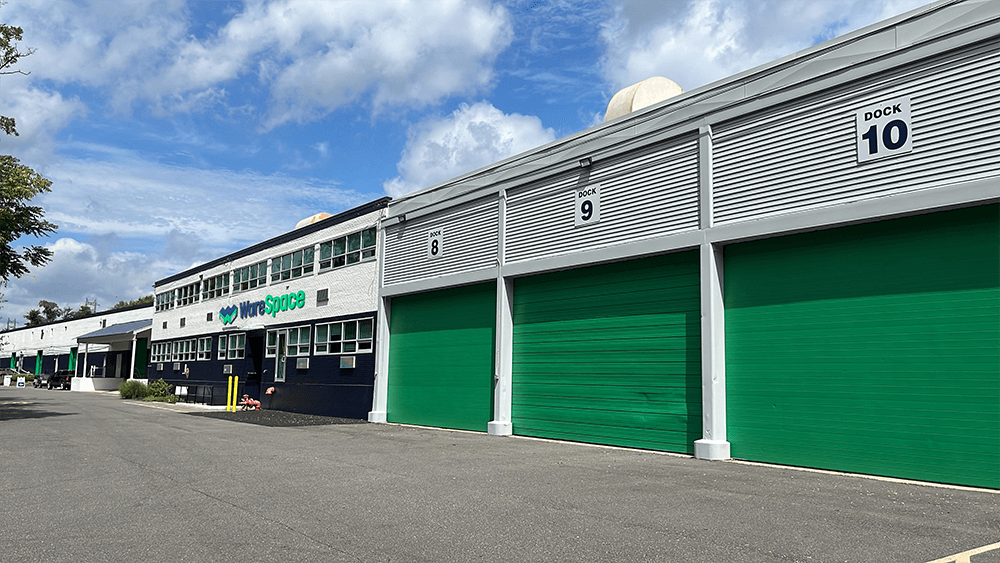
WareSpace Manayunk at 3500 Scotts Lane sits in Philadelphia’s East Falls neighborhood, adjacent to the Manayunk commercial district. The location balances city accessibility with manageable traffic and parking.
Highway Access:
- I-76 (Schuylkill Expressway): 5 minutes
- Route 1 (City Avenue): 5 minutes
- I-476 (Blue Route): 15 minutes
- PA Turnpike: 20 minutes
Drive Times:
- Center City Philadelphia: 10 minutes
- Philadelphia International Airport: 25 minutes
- Main Line suburbs (Bryn Mawr, Ardmore): 15-20 minutes
- King of Prussia: 20 minutes
- Conshohocken: 10 minutes
Pricing (all-inclusive monthly):
- Small (~200-300 SF): $625/month
- Medium (~400-600 SF): $1,675/month
- Large (~800-1,000 SF): $2,275/month
- X-Large (~1,200-2,000 SF): $3,000/month
What’s included:
- Climate control (heat and AC)
- Electricity
- WiFi
- Loading dock access
- Industrial racking
- Warehouse equipment (pallet jacks, dollies, carts)
- Conference rooms
- 24/7 key card access
- Security (controlled access, video surveillance)
- On-site management
- Daily carrier pickups (FedEx, UPS, USPS)
Other Philadelphia Industrial Corridors
- Northeast Philadelphia (Roosevelt Boulevard / I-95 Corridor) Large industrial zones with highway access. Most available spaces are 5,000+ SF—limited small-bay inventory. Traditional leases dominate with 3-5 year terms.
- Navy Yard Redeveloped industrial campus in South Philadelphia. Mix of office, R&D, and industrial space. Primarily larger tenants; limited availability for small operations.
- Bucks County (Bensalem, Bristol) Suburban industrial parks along I-95 north of the city. Lower property taxes than Philadelphia, reasonable highway access. Primarily 3,000+ SF spaces with traditional lease structures.
- Delaware County (Upper Darby, Chester) Older industrial areas with airport proximity. Lower rents reflect aging building stock. Variable quality; careful evaluation needed.
- Montgomery County (Conshohocken, King of Prussia) Suburban industrial with good highway access. Higher rents than Philadelphia proper; most inventory is larger spaces.
What Philadelphia Small Warehouse Space Costs
Traditional Leases
Commercial industrial space in Philadelphia lists at $9-12/SF annually as base rent, varying by location, building age, and amenities.
The full cost calculation for 600 SF at $10/SF base:
Component
Annual
Monthly
Base rent ($10/SF × 600)
$6,000
$500
Property taxes (NNN, ~$2/SF)
$1,200
$100
Insurance (NNN, ~$0.75/SF)
$450
$38
CAM (NNN, ~$1.50/SF)
$900
$75
Utilities (electric, gas, water)
$2,400
$200
Total occupancy cost
$10,950
$913
Effective rate: $18.25/SF—82% higher than the quoted $10/SF.
Upfront costs for traditional lease:
- Security deposit: $1,800-2,700 (2-3 months)
- First and last month: $1,826
- Basic buildout (electrical, lighting, racking): $3,000-8,000
- Total upfront: $6,600-12,500+
Commitment:
- Term: 3-5 years
- Personal guarantee: Full lease value ($32,000-55,000 exposure)
Co-Warehousing Economics
WareSpace Manayunk medium unit (~400-600 SF):
Component
Monthly
All-inclusive rent
$1,675
Total occupancy cost
$1,675
Upfront costs:
- First month: $1,675
- Security deposit: None
- Buildout: None (space is ready, racking included)
- Total upfront: $1,675
Commitment:
- Term: 6 months
- Personal guarantee: None
Side-by-Side Comparison
Traditional leases cost less per month but require significant upfront capital, personal risk, and long-term commitment. Co-warehousing costs more monthly but preserves capital, eliminates personal liability, and provides flexibility.
The right choice depends on your situation: capital availability, growth trajectory, risk tolerance, and planning horizon.
Philadelphia Small Warehouse FAQs
How much does small warehouse space cost in Philadelphia?
Traditional leases quote $9-12/SF base rent, but actual occupancy costs run $15-20/SF after NNN charges and utilities. For 600 SF, expect $750-1,000/month total. WareSpace Manayunk runs $625-3,000/month all-inclusive depending on unit size.
What’s the minimum lease term for warehouse space in Philadelphia?
Traditional industrial leases typically require 3-5 year commitments with personal guarantees. Co-warehousing options like WareSpace offer 6-month minimums with flexibility to scale up, scale down, or exit.
Do I need loading dock access?
If you’re receiving pallets, handling freight deliveries, or shipping anything larger than parcels, yes. Hand-carrying cases through standard doors doesn’t scale. WareSpace includes shared loading dock access with pallet jacks available.
Is climate control necessary in Philadelphia?
For most businesses, yes. Philadelphia’s temperature range—below freezing to 90°F+ with high humidity—damages unprotected inventory, equipment, and materials. Basic storage units typically lack climate control. WareSpace includes year-round HVAC.
What about 24/7 access?
Essential for most businesses. Early morning job starts, late material drops, weekend work, and emergencies don’t follow business hours. Verify access policies before committing—some facilities restrict hours. WareSpace provides 24/7 key card access.
WareSpace Philadelphia offers small warehouse space from 200-2,000 SF in Manayunk. Climate control, 24/7 access, loading docks, 6-month leases, all-inclusive pricing starting at $625/month. Book a tour to see available units.
 ►
Explore 3D Space
►
Explore 3D Space