
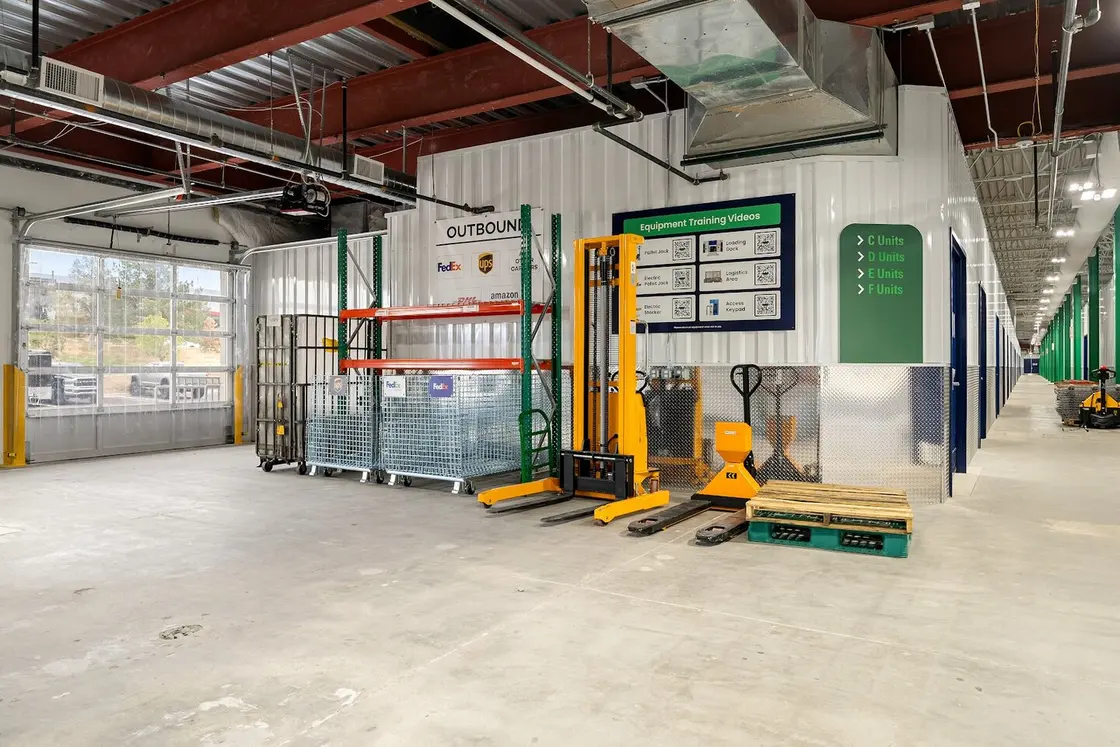
Every Heights storefront has the same quiet problem. The sales floor is the reason customers come in, so it gets the space. The backroom gets whatever is left.
That works until the holiday order lands, a market weekend needs a second tent, or the restaurant buys patio heaters it only uses a few months a year. Then the overflow ends up in an owner’s garage, a car trunk, or a self-storage locker across town. This guide covers how shops, pop-up vendors, and restaurants near the Heights handle overflow, and when a small warehouse unit makes more sense than a storage locker.
Why backroom space runs out first
Retail space near the Heights is not easy to expand. TenantBase’s Houston Q3 2026 market report (accessed November 2026) put Houston retail vacancy at 5.8% in Q2 2026, citing Cushman & Wakefield. The developer of The Grove at West Heights, on its Braun Enterprises property page (accessed November 2026), describes the west Heights as a “supply-constrained” submarket.
When storefront space is tight, adding square footage to a shop is rarely the cheap fix. Moving the stock that does not need to be on the floor usually is. For the bigger picture on Houston space, see our Houston market report.
The City of Houston “Plan a Business” location guide (accessed November 2026) also reminds owners that ongoing expenses like rent can push up what you have to charge. Every Sq Ft of storefront spent on boxes is space that is not selling.
What Heights businesses usually need to store
Overflow inventory
Boutiques and gift shops often buy in bulk to hit better wholesale pricing. The extra cases need somewhere dry, secure, and close enough to restock the floor quickly.
Seasonal and event stock
Holiday merchandise, summer lines, market-day tents, tables, signage, and display fixtures all spend most of the year waiting. Pop-up vendors in particular need a place to load out on Friday and unload on Sunday night.
Restaurant equipment
Restaurants accumulate equipment they do not use every day: spare chairs and tables, patio furniture and heaters, catering gear, event décor, and smallwares bought for a busy season. Storing equipment is different from storing food, and the rules are different too.
Self-storage vs a business warehouse unit
Self-storage and business warehouse units can look similar from the outside. They are built for different jobs.
| Self-storage unit | Business warehouse unit | |
|---|---|---|
| Built for | Personal and household storage | Business inventory, equipment, and light operations |
| Deliveries | Often you must be there to receive; ask each facility | Shared loading access is standard in the WareSpace model |
| Access | Gate hours vary by facility | 24/7 access in the WareSpace model |
| Climate | Climate control is often an upgrade | Year-round HVAC in the WareSpace model |
| Working inside | Usually storage only | Packing, kitting, and light assembly allowed within the use policy |
| Racking and WiFi | Usually bring your own | Racking and WiFi included in the WareSpace model |
| Pricing | Rent plus add-ons vary by facility | All-inclusive Monthly License Fee, from $1,000/mo |
The short version: if you only need to park a few boxes and visit once a month, a locker can be enough. If you receive shipments, restock weekly, prep for events, or want staff to work there, a business unit fits better. Our Houston Heights last-mile delivery guide covers the delivery side for businesses that ship to customers.
A food-safety caution for restaurants
Equipment is not food: the WareSpace Acceptable Use Policy lists storage of inventory, materials, and equipment as acceptable, and lists food manufacturing and commercial kitchens as not permitted. Do not plan to store ingredients, perishables, or prepared food in a WareSpace unit without confirming your exact use against the policy first. Your food permit and health rules may also limit where food can be kept. This guide is not legal or regulatory advice.
The safest way to use off-site space as a restaurant is to keep it for clean, non-food items: furniture, fixtures, décor, catering equipment, and backstock of non-food supplies. Keep food storage in permitted spaces that meet your health requirements.
Deliveries and receiving
Receiving is where a storage plan succeeds or fails. Before you choose a space, ask:
- Who signs for shipments? If nobody can accept freight on your behalf, someone has to be on site for every delivery window.
- Where does the truck go? Shared loading access and nearby parking make freight and box truck drop-offs much easier than a residential street or a crowded strip center lot.
- How fast can you restock? A location close to your shop matters more than a slightly cheaper one across town.
- Can you work there? Breaking down cases, tagging stock, and prepping event kits all go faster in a space where you can stand and work.
For WareSpace Houston Heights, details like receiving support will be confirmed before leasing. In the WareSpace model, shared loading access and on-site support are standard.
When to move overflow off-site
A few signs it is time:
- The backroom is full and stock is creeping onto the sales floor.
- You turn down bulk buys or wholesale deals because there is nowhere to put them.
- Event and market gear lives in personal garages and cars.
- Staff spend more time searching for stock than selling it.
- You are paying for a storage locker and still driving across town to restock.
The City of Houston new business guide (accessed November 2026) notes that Houston has no comprehensive zoning ordinance, but some uses, including alcohol sales, have distance requirements. If your overflow includes regulated items, check the rules before you move them.
WareSpace Houston Heights, coming soon
WareSpace Houston Heights is coming soon to 1215 Seamist Dr, Houston, TX 77008, in the Timbergrove and Lazybrook area inside Loop 610, just west of the Houston Heights. There is no public opening date yet, and tours are not open. The next step is joining the Founders List.
The building is less than 1 mile from the I-610 North Loop, about 1 mile from US-290, and about 2 miles from I-10. Downtown Houston is about 7 miles away and The Galleria about 6 miles.
Final unit mix, pricing, and building features for Houston Heights will be confirmed before leasing. The WareSpace model generally includes private units with racking, shared loading access, year-round HVAC, WiFi, utilities, 24/7 access, and on-site support, in one all-inclusive Monthly License Fee from $1,000/mo on 6 to 12 month leases.
To get updates first, join the Houston Heights waitlist. Need space now? See all WareSpace Houston locations, including WareSpace Northwest at 10795 Hammerly Boulevard, which is leasing now.
Retail and restaurant storage FAQs
Can I store restaurant equipment in a WareSpace unit? Storage of equipment is an acceptable use under the WareSpace Acceptable Use Policy. Commercial kitchens and food manufacturing are not permitted, so confirm your exact use before leasing.
Can I store food or ingredients? Do not assume so. Check your use against the Acceptable Use Policy with the WareSpace team, and against your own food permit and health rules, before you plan any food storage.
Is a warehouse unit better than self-storage for a boutique? If you receive deliveries, restock often, or prep for events, a business unit with loading access and room to work usually fits better than a locker.
When will WareSpace Houston Heights open? There is no public opening date yet. Join the Founders List to hear when details are confirmed.


