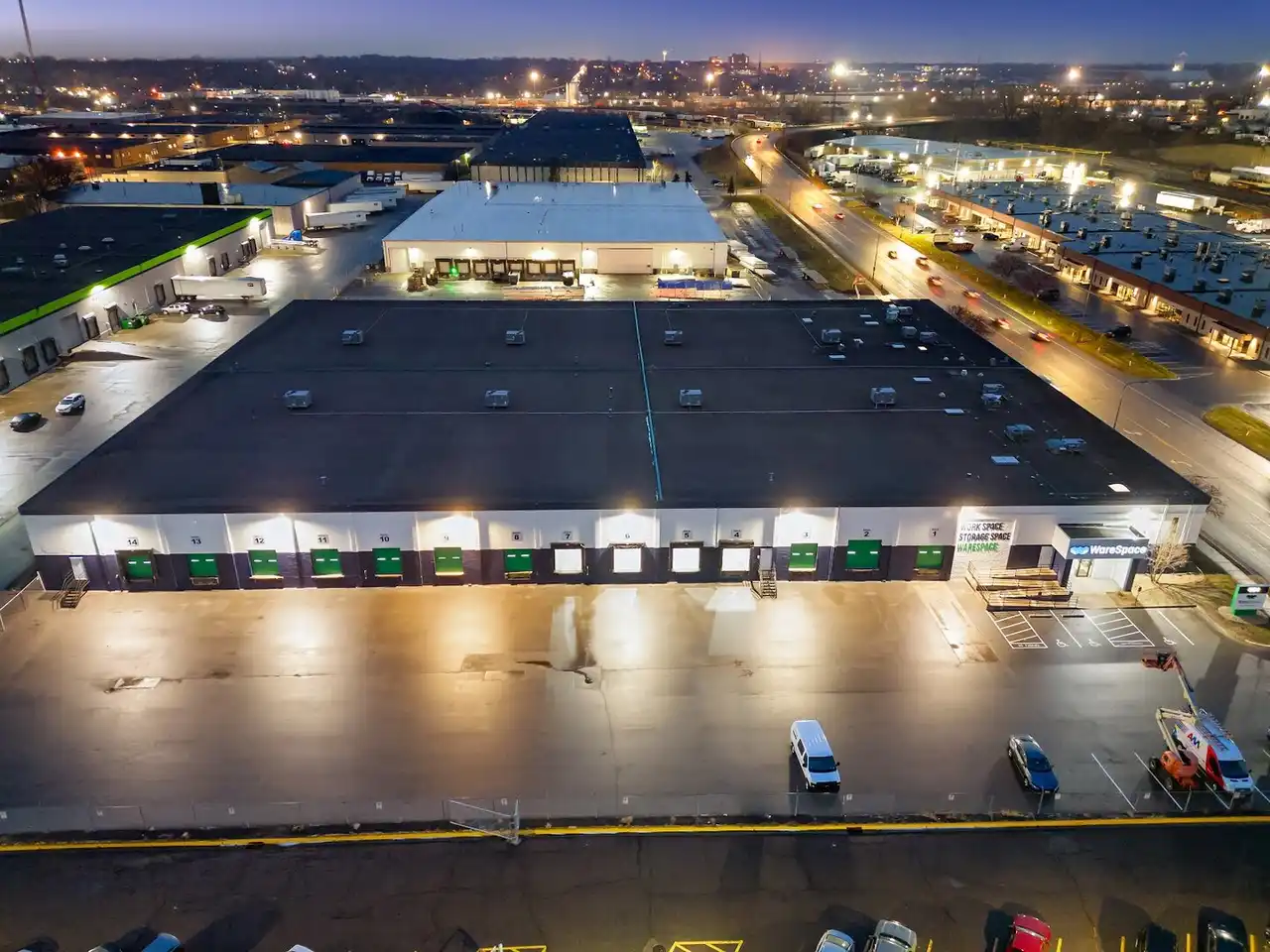
Small-bay industrial is the most supply-constrained segment of U.S. commercial real estate. Vacancy sits at roughly half the national average, new construction is effectively nonexistent, and demand is accelerating from every direction at once.
Within that segment, the smallest end of the spectrum, what we call micro-bay industrial (units under 5,000 Sq Ft), faces even more acute constraints. WareSpace focuses on the 200 to 2,000 Sq Ft range inside this category, the space where small businesses actually operate but where almost nothing new is built.
Executive Summary
Small-bay industrial is the most supply-constrained segment of U.S. commercial real estate. Vacancy rates sit at half the national average, new construction is effectively nonexistent, and demand is accelerating from every direction. Within this segment, the smallest end of the spectrum, what we call micro-bay industrial (units under 5,000 Sq Ft), faces even more acute constraints. WareSpace focuses on the 200 to 2,000 Sq Ft range within this category.
The supply problem
Small-bay properties make up 29% of existing industrial inventory but represent less than 2% of the construction pipeline. Why? New small-bay development costs $160 to $220 per Sq Ft (depending on where in the country) versus $95 to $140 per Sq Ft for big-box logistics. Developers cannot make the economics work, so they do not build. Meanwhile, existing small-bay properties trade at 40%+ discounts to replacement cost, signaling just how hard it would be to replicate this inventory today. The result: 4.2% vacancy for small-bay versus 7.5% for overall industrial, the largest gap ever recorded.
A note on data availability: industry research firms (CoStar, CBRE, JLL, Cushman & Wakefield) do not publish vacancy data for spaces under 10,000 Sq Ft, because the market is too fragmented to track at that level. Throughout this report we use sub-10K and sub-15K Sq Ft vacancy data as proxies for the micro-bay segment. We define micro-bay as sub-5,000 Sq Ft and small-bay as sub-50,000 Sq Ft, the segments where supply constraints are most acute and where co-warehousing operators concentrate. The actual vacancy rate for spaces under 5,000 Sq Ft is likely even tighter than the figures cited, but cannot be precisely measured with available third-party data.
The demand side
Four forces are converging on small-bay demand simultaneously:
- Tariffs and trade uncertainty. Depending on measurement (headline vs. effective rates), U.S. tariffs currently range from about 17% to over 22%, the highest levels since the early 20th century. Companies are stockpiling inventory, and they need space to put it.
- Reshoring momentum. 244,000 manufacturing jobs were announced via reshoring in 2024 alone. The second million reshoring jobs took just 4 years versus 10 years for the first million.
- E-commerce growth. Projected to hit $1.47 trillion in 2025, e-commerce requires roughly 3x more warehouse space than traditional retail, and last-mile fulfillment needs small, urban facilities.
- Record entrepreneurship. 473,679 new business applications per month, the strongest 4-year streak on record. These businesses need space to operate.
Capital is paying attention
Institutional investors have caught on. Small-bay transactions represented 62% of industrial deal volume in 2024. Institutional buyers increased their market share to 23% in Q1 2025, up from 16% just two years prior. The headline deal: BKM Capital Partners and Kayne Anderson Real Estate launched a $1.5 billion joint venture in 2025 specifically targeting small-bay acquisitions. That is serious capital chasing a category that was institutionally underrepresented just a decade ago.
The gap that created the opportunity
Traditional industrial real estate has ignored small businesses for decades. Co-warehousing and micro-bay industrial fill this gap: purpose-built facilities with units from 200 to 2,000 Sq Ft, short-term leases, and shared infrastructure that lets small businesses operate professionally without the traditional warehouse headaches.
| Option | Size | The reality |
|---|---|---|
| Garage or spare bedroom | Under 500 Sq Ft | Where most entrepreneurs start |
| Self-storage unit | 100 to 500 Sq Ft | Storage only, no loading docks, no operations |
| The gap | 500 to 5,000 Sq Ft | Almost nothing available |
| Traditional warehouse | 5,000 to 50,000 Sq Ft | 3 to 5 year leases, personal guarantees, NNN complexity |
| Big-box logistics | 50,000+ Sq Ft | Built for enterprise, not small business |
For a closer look at how the co-warehousing model works in practice, see our overview of co-warehousing for small businesses.
What this report covers
- Defining the category. What micro-bay and small-bay mean, and where co-warehousing fits.
- The supply crisis. Why vacancy is half the national average and why developers will not build.
- Demand drivers. Tariffs, reshoring, e-commerce, and the entrepreneurship boom in detail.
- Metro market spotlights. Key markets with vacancy, rent, and demand data.
- Investment landscape and outlook. Where institutional capital is flowing, the operators shaping the category, and what to watch.
2025 at a glance
The Supply Crisis
The small-bay industrial market has a math problem: demand keeps growing, but supply does not. It is structural, baked into the economics of development, the realities of construction costs, and the way capital has flowed for decades. Understanding why supply cannot catch up is essential to understanding why this asset class behaves differently from the rest of industrial real estate.
The numbers
Small-bay properties account for 29% to 36% of existing U.S. industrial inventory, depending on how you define the category. But they represent less than 2% of the construction pipeline, and by some measures, as little as 0.3%.
To put that in perspective: only 23 million square feet of small-bay industrial space is under construction across the entire United States. Meanwhile, developers delivered 400+ million square feet annually of mostly large-format logistics space in recent years.
The result: small-bay inventory grew just 3% over the past decade. During that same period, employment in industries that rely heavily on small-bay space (construction, wholesale trade, technical contractors, and residential services) grew by 20%. Demand up 20%, supply up 3%. It is a decade-long mismatch with no end in sight.
Why developers do not build small
The economics of small-bay development simply do not work for most builders.
- Construction costs have exploded. The warehouse construction cost index shows a 44% increase from the start of the pandemic to today. As of early 2025, medium-sized warehouse construction averages $85 per Sq Ft, while large projects come in around $77 per Sq Ft. But small-bay development, with its higher per-unit costs for demising walls, HVAC systems, electrical, plumbing, and common areas, runs significantly higher, often $160 to $220 per Sq Ft or more for quality multi-tenant product.
- No economies of scale. Building a 500,000 Sq Ft distribution center lets developers spread fixed costs across massive square footage. Building twenty 5,000 Sq Ft units in a multi-tenant property does not. The entitlement process, site work, and permitting take nearly as long for a small project as a large one, but the revenue potential is a fraction.
- Land constraints. The infill locations where small-bay demand is strongest are exactly where developable land is scarcest and most expensive. Urban cores, established industrial corridors, and transit-accessible sites command premium prices that make the math even harder.
- Financing challenges. Lenders prefer the simplicity of single-tenant deals with long-term credit tenants. Multi-tenant small-bay, with its operational complexity, shorter leases, and diverse tenant base, requires more specialized underwriting. Many traditional lenders simply will not touch it.
The bottom line: it is prohibitively expensive to build anything below 75,000 Sq Ft because builders cannot achieve the economies of scale that make larger projects profitable.
The replacement cost gap
Here is what makes existing small-bay assets so valuable: comparable buildings sell below today’s replacement costs.
Many of these properties, often 20, 30, or 40+ years old, would be nearly impossible to replicate today. The land is not available. The zoning does not exist. The construction costs do not pencil. And yet these vintage buildings, properly maintained and upgraded, continue to perform exceptionally well.
This creates a structural advantage for existing asset owners. When you can acquire a property at 40%+ discounts to replacement cost, you are buying into a market where new competition simply cannot be built at a price that threatens your position.
As one investor noted: “We have purchased these buildings well below replacement cost with below-market rents.” That combination creates embedded upside that does not depend on market conditions improving.
Vacancy: the proof point
The supply shortage shows up clearly in vacancy data.
Small-bay vacancy (under 50K Sq Ft) sits at 4.2%, roughly half the 7.5% vacancy rate for overall industrial. At the micro-bay level (under 5K Sq Ft), vacancy is even tighter. Though precise data is not available, the closest proxy (sub-10K Sq Ft) shows just 3.5% availability. To put that in context, CoStar notes that small-bay vacancy is within one percentage point of the apartment vacancy rate in New York City, a market known globally for its perennial housing shortage.
The divergence is even starker when you compare small-bay to the big-box segment that dominated development over the past decade. Vacancy in properties over 150,000 Sq Ft is now nearly double that of smaller properties. Developers overbuilt large logistics space while ignoring small-bay entirely.
Even in a scenario where small-bay tenant demand contracted as dramatically as it did during the 2009 financial crisis, vacancy would remain more than 50 basis points below its pre-pandemic 15-year average. The supply deficit is that severe.
Rent growth reflects the shortage
When supply cannot meet demand, rents rise. And small-bay rents have risen dramatically.
Rents for small-bay suites under 50,000 Sq Ft have grown over 40% since 2020, compared to roughly 30% for the broader industrial market. In many markets, asking rents have roughly doubled over the past decade, from $5 to $6 per Sq Ft NNN to $12 to $15 per Sq Ft NNN for quality space in desirable locations.
The geographic pattern is notable: rent growth in the top 10 highest-rent metros has begun to plateau (up just 1.6% for small-bay in markets like LA, San Diego, NYC, and Seattle), but secondary markets are still seeing 5.9%+ annual growth. The supply shortage is spreading outward from gateway cities to emerging markets. CompStak projects that small-bay rent growth will outpace bulk industrial in 2025, continuing a multi-year trend of divergence between the two segments.
Why this will not change soon
Even with rents at record highs, the supply response will be minimal.
- The pipeline remains tiny. Whatever gets built in 2025 to 2026 represents less than 0.5% of existing stock. Even if small-bay construction doubled, it would barely register against demand.
- Construction starts have slowed across all industrial. Nationwide industrial space under construction is down 25% year-over-year. Developers are pulling back broadly, not pivoting to small-bay.
- Interest rates remain elevated. Higher financing costs make speculative development harder to pencil, particularly for operationally intensive multi-tenant projects.
- New projects pre-lease immediately. The few small-bay developments that do get built are largely pre-leased or sold out before completion. In Las Vegas, a new small-bay project delivered in 2022 reached full occupancy within one month. Supply gets absorbed instantly.
The data points in one direction: small-bay supply will remain structurally constrained for years. The shortage is not a temporary dislocation, it is a persistent feature of the market.
What this means for investors
The supply crisis creates a specific investment thesis:
- Existing assets appreciate. When you cannot build new competition, existing properties become more valuable. Owners can raise rents, improve occupancy, and sell at higher multiples, all because tenants have nowhere else to go.
- Downside protection is built in. Even in economic downturns, the supply shortage provides a floor. As one investor put it: “When combined with prohibitive land costs that often prevent the development of small infill sites and limit competition from new supply, there is a compelling case for the downside protection small bay industrial offers in a shaky economic environment.”
- Adaptive reuse becomes the path to supply. With new ground-up development uneconomic, the growth strategy shifts to converting existing properties (obsolete retail, dated office, underperforming industrial) into modern small-bay facilities. This is exactly the model WareSpace and other co-warehousing operators have built their businesses around.
- Operational expertise matters more. In a market where you cannot simply build your way to returns, the value creation comes from management: leasing velocity, tenant retention, rent optimization, capital improvements. The operators who excel at running multi-tenant portfolios will capture disproportionate returns.
The supply crisis in one chart
| Segment | Share of existing inventory | Share of construction pipeline |
|---|---|---|
| Small-bay (under 75K Sq Ft) | 29 to 36% | under 2 to 5% |
| Mid-bay (75K to 150K Sq Ft) | ~15% | ~8% |
| Big-box (150K+ Sq Ft) | ~50% | ~87% |
Sources: CoStar, Matthews, Rectangle Group, Corebridge Financial. The mismatch is stark. Small-bay is structurally underbuilt, and that is not changing anytime soon.
Built for the gap nobody else fills
Operate from real industrial space without the big-box lease
WareSpace provides all-inclusive small warehouse units from 200 to 2,000+ Sq Ft with loading docks, HVAC, industrial racking, and short-term leases, starting at $1,000/mo, in metros across the country. No personal guarantees, no NNN math.
Demand Drivers
Small-bay industrial demand is not growing because of a single trend. It is accelerating because four structural forces are hitting the market simultaneously, together creating unprecedented pressure on an already undersupplied segment.
1. Tariffs and trade policy: the inventory surge
The United States is operating under the highest tariff rates in nearly a century. According to The Budget Lab at Yale, the average effective tariff rate reached 16.8% as of November 2025, the highest since 1935. Earlier in the year, headline rates peaked near 22.5% (the highest since 1909), while effective rates peaked at nearly 19%. The distinction matters for analysis, but the directional signal is clear: tariff policy is reshaping supply chains and driving warehouse demand.
The stockpiling effect is massive. Data from supply chain technology provider Deposco shows a 228% increase in Days of Inventory on Hand between February and April 2025 as companies raced to front-load imports before tariff deadlines. Prologis reports warehouse utilization averaged 85% in Q2 2025, up 50 points from the 2024 average, driven by customers front-loading inventories in response to changing trade policies. This does not appear temporary. The Logistics Manager’s Index hit 62.8 in February 2025, the fastest expansion reading since June 2022, with inventory costs at 77.3 and warehousing prices at 77.0.
Small-bay benefits disproportionately. The companies most affected by tariffs, small and mid-sized importers who lack the capital to absorb costs or the leverage to negotiate with suppliers, are precisely the businesses that need small-bay space. A 2025 survey from the Toy Association found that nearly half of U.S. toy companies could go out of business if current tariffs persist, citing the inability to pivot fast enough to remain competitive. These businesses need flexible, right-sized warehouse space to manage inventory buffers without committing to long-term big-box leases.
2. Reshoring and manufacturing reindustrialization
Manufacturing is coming back to the United States at a pace not seen in decades. The Reshoring Initiative’s 2024 Annual Report shows that 244,000 U.S. manufacturing jobs were announced in 2024 via reshoring and foreign direct investment (FDI). Since 2010, over 2 million jobs have been announced through these channels. The acceleration is striking: the second million reshoring jobs took just 4 years versus 10 years for the first million.
Tariffs are now a primary motivator. According to the Reshoring Initiative, tariffs were cited in 454% more cases in 2025 versus 2024 as a key factor driving reshoring decisions. Government incentives, by contrast, were cited 49% less frequently as previous subsidies phase out.
The geography of reshoring favors small-bay. Reshored manufacturing does not arrive as massive 500,000 Sq Ft distribution centers. It comes as dozens of small and mid-sized manufacturers setting up domestic production: tool and die shops, component suppliers, specialty fabricators, and light assembly operations. These businesses typically need 2,000 to 15,000 Sq Ft of industrial space, squarely in the small-bay sweet spot. The Initiative notes that low-tech industries remain under-reshored, leaving U.S. supply chains vulnerable for mass-market consumer goods, a significant pipeline of future small-bay demand.
The policy tailwinds continue. Even with government incentives declining from their peak, bipartisan support for American industrial competitiveness remains strong. The CHIPS Act, IRA, and Infrastructure Bill created the initial wave; tariff policy is creating the sustained push. And manufacturing apprenticeships have risen 83% over the past decade, indicating workforce investment to support the trend.
3. E-commerce: relentless growth, relentless space demand
E-commerce continues its structural growth, and every dollar of online sales requires more warehouse space than traditional retail. According to the U.S. Census Bureau, retail e-commerce sales hit $304.2 billion in Q2 2025 (seasonally adjusted), up 5.3% from Q2 2024. E-commerce now represents 16.3% of total retail sales, continuing its steady climb from 11.9% in Q1 2020.
The math on warehouse demand is straightforward. Industry estimates consistently show that e-commerce requires 2.5x to 3x more warehouse space per dollar of sales than traditional retail.
Small-bay serves the long tail. Amazon and Walmart handle the massive volume, but millions of e-commerce sellers need their own space. The SBA reports 34.8 million small businesses in the United States, and the retail industry saw the biggest driver of new business application growth during the pandemic, with applications nearly doubling from 525,000 in 2019 to nearly 1 million in 2021. These sellers graduate from garage operations and need professional space for inventory storage, fulfillment, and shipping, but do not need 50,000 Sq Ft distribution centers. They need 500 to 3,000 Sq Ft with dock access, climate control, and carrier pickups. That is exactly what micro-bay and co-warehousing provide.
Last-mile logistics creates urban demand. As delivery expectations compress to same-day and next-day windows, e-commerce fulfillment pushes closer to population centers. Urban and infill industrial locations, where small-bay properties dominate due to parcel constraints and zoning, become increasingly valuable. Big-box logistics simply cannot serve this need; the buildings do not fit the parcels.
4. The entrepreneurship boom: record business formation
The United States is experiencing the strongest period of business formation in its history. According to the U.S. Census Bureau’s Business Formation Statistics, business applications have averaged 430,000 to 480,000 per month since 2021, roughly double the pre-pandemic baseline of 280,000 to 300,000 monthly applications. The 2021 to 2024 period represents the strongest four-year streak of business formation on record.
These are not just consulting LLCs. The Census Bureau tracks high-propensity business applications, those most likely to result in employer businesses with payroll, and these have also remained elevated, indicating real business formation activity rather than just tax entity creation.
Small businesses need small spaces. The SBA’s 2024 data shows:
- 34.8 million small businesses in the United States
- Small businesses employ 45.9% of private sector workers (59 million people)
- Small businesses represent 43.5% of GDP
- Small businesses pay 39% of all private sector payroll
These businesses eventually outgrow home offices, garages, and spare bedrooms. When they do, the traditional industrial real estate market has nothing for them. Self-storage units do not allow business operations. Traditional warehouse leases start at 5,000+ Sq Ft with 3 to 5 year terms and personal guarantees. For every Amazon-scale operation, there are thousands of small businesses that need 200 to 2,000 Sq Ft of professional warehouse space, and their numbers are growing faster than at any point in American economic history.
The demand convergence
What makes the current moment unique is not any single demand driver, it is the simultaneous convergence of all four:
| Driver | Key metric | Small-bay impact |
|---|---|---|
| Tariffs | 17% to 22% (effective to headline rates) | Inventory buffers require flexible space |
| Reshoring | 244,000 jobs announced (2024) | Small manufacturers need right-sized facilities |
| E-commerce | 16.3% of retail, $304B quarterly | Fulfillment operations at every scale |
| Entrepreneurship | 430K+ monthly business applications | Record business formation needs space to grow |
Each driver individually would increase small-bay demand. Together, they create compounding pressure on a segment that was already severely undersupplied before any of these trends accelerated. The supply constraints detailed above exist precisely because demand has outstripped supply for years. These four factors signal that gap will continue to widen, not close.
What this means for the market
- For occupiers: Competition for quality small-bay space will intensify. Businesses should expect continued rent growth, longer waitlists at desirable facilities, and limited negotiating leverage on lease terms. Securing space early, even before it is needed, becomes a strategic advantage.
- For investors: Demand fundamentals are as strong as they have been in the history of the asset class. The combination of structural undersupply and accelerating demand creates favorable conditions for rent growth, occupancy, and asset appreciation. Markets with strong reshoring activity, e-commerce penetration, and entrepreneurship rates warrant particular attention.
- For developers and operators: Operators who can efficiently transform older industrial, retail, or flex properties into multi-tenant small-bay facilities have significant runway ahead.
Metro Market Spotlights
The national story, around 4% small-bay vacancy versus 7.5% overall, plays out differently across metros. Some markets show even sharper divergence. Others face unique dynamics worth understanding. Here is what the data shows in the markets where small-bay demand is strongest, and where WareSpace is positioning for growth.
A note on metrics: in many markets, small-bay overlaps with flex and light manufacturing categories. Metrics are cited using the closest available proxy where sub-15,000 Sq Ft data is unavailable.
Dallas-Fort Worth
The divergence capital. 4 WareSpace locations, 650,000 Sq Ft portfolio. DFW shows the clearest split between small-bay and big-box performance in any major U.S. market, and WareSpace has bet heavily on this thesis.
| Metric | Small-bay | Overall market |
|---|---|---|
| Vacancy rate | 6.1% to 6.3% (flex) | 9.1% to 9.2% |
| Market asking rents (comparable properties, CoStar) | $13.66 to $13.79/Sq Ft | $9.70/Sq Ft |
| Leasing velocity | 1 to 3 months | 6+ months |
Since 2020, DFW added 239 million Sq Ft of new industrial space, nearly all of it large-format logistics. There are typically fewer than ~150 actively marketed options at any given time for small businesses seeking under 2,000 Sq Ft in the DFW area, despite this segment representing 25% of inventory. Buildings under 50,000 Sq Ft show about 6% availability versus 15% for buildings over 500,000 Sq Ft. The Western Lonestar/Turnpike corridor maintains sub-2% small-bay availability, and infill submarkets command 50%+ rent premiums over warehouse/distribution space.
Our newest addition is Plano (174,500 Sq Ft), a former big-box retail property at 700 E Plano Parkway with George Bush Turnpike frontage. The Plano City Council unanimously approved rezoning for our adaptive reuse project, which will serve 160+ small businesses. The acquisition brought our DFW metro total to 650,000 Sq Ft, our largest regional footprint nationally. Population growth of 2 million residents since 2010 drives sustained demand, and Blackstone and Goldman Sachs expanding presence (including a $500M downtown Dallas office campus) signals institutional confidence despite elevated overall vacancy.
Phoenix
Big-box oversupply, small-bay shortage. WareSpace South Tempe opened January 2026. Phoenix delivered more industrial space than any Sun Belt market from 2020 to 2024, and most of it is struggling to lease. Small-bay is a different story entirely.
| Metric | Small-bay | Overall market |
|---|---|---|
| Vacancy rate | 5.6% (under 100K Sq Ft) | 10.9% to 13.4% |
| Construction pipeline | Virtually none | Down from 28M Sq Ft to 11.2M Sq Ft |
| Market rent growth | At record highs | Flat to declining |
Phoenix’s direct industrial vacancy fell to 10.9% in Q2 2025, the first quarterly drop after seven straight quarters of increases. This was not driven by demand collapse; it happened because new deliveries cooled dramatically to just 3.5 million Sq Ft in Q2 (the lowest quarterly volume since 2021) while net absorption remained strong at 2.6 million Sq Ft. When big spec buildings stop flooding the market, it takes pressure off smaller spaces. Spaces under 100,000 Sq Ft sit at 5.6% vacancy, nearly half the broader market’s rate. Phoenix added 128 million Sq Ft between 2020 and 2024 (a 29% inventory jump), but that wave is now receding.
Arizona is home to over 650,000 small businesses, 99.5% of all Arizona businesses. The state added 118,015 new LLCs in 2024 alone and ranks #8 nationally for new business growth. As one Phoenix-based e-commerce operator told us: “When we started looking in 2022, we had maybe two options for spaces under 2,000 Sq Ft. Now everyone’s calling us about availability in those larger spec buildings, but we don’t need 50,000 square feet, we need 1,500 Sq Ft with dock access and flexible terms.”
WareSpace South Tempe sits at 9801 S. 51st Street, 2 minutes from I-10 and equidistant to Tempe and Chandler in the Southeast Valley, the corridor with the highest small business density in the metro and the tightest small-bay supply. We are entering Phoenix precisely as the market transitions from oversupply to equilibrium.
Denver
Mountain West momentum. 2 WareSpace locations, 200,000 Sq Ft portfolio.
| Metric | Small-bay | Overall market |
|---|---|---|
| Vacancy rate | Below 5% (infill) | 6.5% to 7.5% |
| Market rent growth | Steady increases | Moderating |
| Construction | Limited small-bay | Mostly large-format |
Denver’s entrepreneurial ecosystem continues driving demand for flexible small-bay space. Infill locations near population centers command premiums, while large-format vacancy has risen with new deliveries. Centennial (71,000 Sq Ft) is our first Denver location, a converted call center: “It’s a beautiful building, single story office, no docks, doesn’t look like a warehouse, but beautiful natural light all around it. We built and put in dock wells and basically retrofit a defunct call center.” (Jeff Jenkins, VP Acquisitions). Park Hill (129,000 Sq Ft) is an off-market acquisition at 5150 Colorado Blvd, just off I-70, with 40+ dock doors, minutes from downtown Denver, opening Spring 2026.
We target buildings that are functionally obsolete: low clear heights, poor circulation, limited parking. As Jeff Jenkins put it: “We can upfit a dysfunctional product, buildings that don’t have great ingress/egress access, buildings that are functionally obsolete. We’re trying to find warehouses in non-industrial warehouse-y spaces.”
Washington D.C. / Northern Virginia
The tightest market in the nation. 2 WareSpace locations, opening early 2026. Northern Virginia maintains some of the lowest industrial vacancy rates in the country and the highest barriers to new supply.
| Metric | Data point |
|---|---|
| Overall vacancy | 4.0% to 4.8% |
| Market asking rents (comparable properties) | $16.61 to $16.79/Sq Ft NNN |
| Construction pipeline | 448K to 792K Sq Ft (multi-year low) |
The D.C. metro industrial market maintains sub-5% vacancy rates, roughly half the national average. But the bigger story is supply: just 448,000 to 792,000 Sq Ft is under construction, the lowest level since 2021. Land scarcity and competition with data center development have effectively eliminated new small-bay supply. Market asking rents for comparable industrial space average $16.61 to $16.79/Sq Ft NNN, among the highest in the mid-Atlantic. WareSpace Alexandria (100,000 Sq Ft) at 950 S Picket Street was a $19.5M off-market transaction via JLL, minutes from the I-395/I-495 connector and 20 minutes to downtown D.C., opening early 2026.
South Florida (Fort Lauderdale)
New market entry. WareSpace facility #20, a 2M+ Sq Ft portfolio milestone. The Fort Lauderdale acquisition marked two milestones: WareSpace’s 20th facility and the portfolio exceeding 2 million square feet nationwide.
| Metric | Data point |
|---|---|
| Building size | 60,000 Sq Ft |
| Location | 700 NW 57th Court, Broward County |
| Position | Minutes from I-95, 15 minutes to downtown Fort Lauderdale |
| Expected tenants | 100+ small businesses across the tri-county metro |
The tri-county area (Broward, Miami-Dade, Palm Beach) represents one of the most dynamic small business markets in the country, but traditional warehouse options largely ignore businesses operating between garage startups and full-scale distribution. E-commerce sellers running operations from Coral Springs garages, Hialeah contractors managing inventory from storage units, creators in Wynwood turning down orders because they have nowhere to store products. The problem is consistent across markets: industrial real estate jumps from storage units to massive warehouse leases, with nothing for growing businesses in between.
Atlanta
Small deals dominating. 2 WareSpace locations. Atlanta’s big-box market shows strain. Small-bay tells a completely different story, and investors are noticing.
| Metric | Small-bay | Overall market |
|---|---|---|
| Vacancy rate | 3.7% to 4.1% (under 50K Sq Ft) | 8.6% to 9.0% |
| Share of leasing | 87% of deals | — |
| Investment share | 35% of volume (up from 20%) | — |
Warehouses under 100,000 Sq Ft had just 3.7% vacancy in early 2024, compared to 9%+ for distribution centers averaging 700,000 Sq Ft. More striking: buildings under 50,000 Sq Ft accounted for 87% of all lease transactions. Since 2021, the share of annual industrial investment volume allocated to smaller assets has risen from roughly 20% to 35% by 2025. Georgia’s seaports and I-85/I-20 corridors make Atlanta North America’s fifth-largest big-box market, but the same infrastructure supports small importers, e-commerce operators, and light manufacturers.
Chicago
Structural undersupply in the Midwest’s hub. 2 WareSpace locations, 120,000 Sq Ft portfolio. The nation’s largest industrial market maintains tight conditions overall, and even tighter conditions in small-bay.
| Metric | Small-bay | Overall market |
|---|---|---|
| Vacancy rate | Below 3% (core infill) | 5.3% to 5.9% |
| Market rent growth | +30% since 2020 | +4.2% YoY |
| Large-bay vacancy | — | 7% to 8% (500K+ Sq Ft) |
Small-bay vacancy has stayed below 4% for five consecutive years in core Chicago submarkets, while large-bay vacancy (500K+ Sq Ft) has climbed to 7% to 8%. Market asking rents for small-bay are up 30% since 2020 while large-format rent growth has flattened. The O’Hare/Elk Grove/North Cook corridor remains one of the tightest industrial corridors in the nation, with essentially no land for new small-bay development. The City of Chicago’s Small Business Improvement Fund offers up to $250,000 in reimbursement grants for industrial property improvements, with multi-tenant properties eligible for up to $100,000 per tenant.
Houston
The port city advantage. 1 WareSpace location. Houston has avoided the oversupply problems plaguing other Sun Belt markets, and small-bay fundamentals remain exceptionally strong.
| Metric | Small-bay | Overall market |
|---|---|---|
| Vacancy rate | Sub-5% (core submarkets) | 7.3% to 7.4% |
| Absorption streak | — | 59+ consecutive quarters positive |
| Manufacturing vacancy | 2.0% to 2.4% | — |
Houston recorded 59 consecutive quarters of positive absorption before a recent pause. Unlike DFW and Phoenix, Houston has not overbuilt small-bay space, creating runway for continued rent growth in sub-50,000 Sq Ft facilities. Manufacturing vacancy stands at just 2.0% to 2.4%, extremely tight. The Northern Outer Loop submarket, where two-thirds of inventory is properties under 30,000 Sq Ft, maintains 5.2% vacancy with demand concentrated in sub-15,000 Sq Ft spaces. Well-leased warehouses under 40,000 Sq Ft priced at or under $5 million remain popular investments according to Matthews Real Estate.
Philadelphia
Manufacturing resilience. 1 WareSpace location. Philadelphia’s overall vacancy has climbed, but manufacturing and small-bay segments tell a different story.
| Metric | Manufacturing | Overall market |
|---|---|---|
| Vacancy rate | 3.5% | 8.9% |
| Market rent growth | +4.1% YoY | — |
| Market asking rent (comparable manufacturing/light industrial) | $11.43/Sq Ft NNN | — |
Overall vacancy reached a record 8.9% by mid-2025, but manufacturing vacancy stands at just 3.5%, nearly half the 6.2% overall industrial rate. The construction pipeline declined 58.5% from the prior year to 6.9 million Sq Ft, which should help stabilize conditions. Southern New Jersey drove 64% of 2024 occupancy gains.
Salt Lake City
The entrepreneurship hotspot. 1 WareSpace location. Utah’s fundamentals stand out: tightest small-bay vacancy in the Intermountain West, combined with the nation’s strongest business formation environment.
| Metric | Small-bay | Overall market |
|---|---|---|
| Vacancy rate | 2.5% (ex-bulk) | 5.9% to 7.4% |
| Absorption growth | +200% YoY | — |
| Construction | 7-year low | 1.75M Sq Ft underway |
Utah ranks #1 as the best state for starting a business, with the greatest access to business loans and the largest annual employment growth at nearly 2.5%. The state’s Startup State Initiative and seven new Inland Port Authority submarkets are driving economic development.
Minneapolis-St. Paul
Midwest stability. 2 WareSpace locations, 200,000 Sq Ft. The Twin Cities maintain vacancy rates significantly below national averages, with limited speculative construction providing supply protection.
| Metric | Data point |
|---|---|
| Overall vacancy | 4.2% to 5.2% |
| Absorption (2024) | 3.2M Sq Ft |
| Investment sales | $1.35B+ (highest since 2022) |
The Twin Cities maintain overall vacancy of 4.2% to 5.2%, significantly below the national average and low among Midwest markets according to Avison Young. Investment sale activity reached $1.35+ billion in 2024, the highest since 2022, signaling institutional confidence. The market’s stability relative to Sun Belt volatility is attracting capital seeking predictable cash flows.
Investment Outlook and Conclusions
The structural case for small-bay industrial is straightforward. The data throughout this report points to the same conclusion: a permanently supply-constrained asset class with durable demand and meaningful downside protection.
Capital is already moving
Institutional investors have recognized what the fundamentals show.
| Indicator | Trend |
|---|---|
| Light industrial share of transaction volume | 58% (2023) to 62% (2024) |
| Institutional buyer share | 16% (2023) to 23% (Q1 2025) |
| Small-bay sales vs. pre-pandemic | +32% above average |
| Big-box sales vs. pre-pandemic | -30% below average |
The BKM Capital Partners and Kayne Anderson $1.5 billion joint venture, specifically targeting small and mid-bay acquisitions, signals that major institutional capital now views this as an established asset class, not a niche play. Cap rates have converged: the historic 50 to 100 basis point premium for small-bay (reflecting management intensity and tenant credit concerns) has compressed to near-zero. In supply-constrained markets, premium small-bay assets trade at 6.0% to 6.5%, comparable to self-storage and tighter than softening big-box logistics.
The competitive landscape
Co-warehousing has emerged as a distinct category, attracting institutional backing from Cox Enterprises, Fundrise, and others. Operators differ mainly in scale, ownership model, and tenant focus:
| Scale | Model | Differentiation |
|---|---|---|
| 30+ locations (WareSpace) | Vertically integrated owner/operator | On-site GMs at every location, full-service small business infrastructure |
| 12+ locations | Sub-lease | DTC e-commerce specialization |
| 30+ locations (U.S. & Canada) | Sub-lease | Broad geographic reach, 90-day leases |
| 7 locations | Mix of sub-lease and owned | Historic building conversions, e-commerce focus |
| 5 locations | Sub-lease | Month-to-month leases, content studio amenities |
WareSpace’s positioning: vertical integration (owning acquisitions through operations), adaptive reuse expertise (converting obsolete buildings others avoid), and broad tenant focus (serving all small businesses, not just e-commerce) create differentiation in an increasingly competitive category.
Strategic implications
For investors. The supply protection is structural and persistent. Construction economics ($160 to $220 per Sq Ft versus $95 to $140 per Sq Ft for big-box logistics) will not change. Infill land scarcity will not resolve. The sub-0.5% construction pipeline relative to existing stock is a structural feature, not a cycle. With existing assets trading at 40%+ discounts to replacement cost, acquiring and upgrading vintage buildings generates better risk-adjusted returns than ground-up development. In a market where you cannot build your way to returns, value creation comes from management, and multi-tenant operational intensity (historically a deterrent) is now a competitive advantage for specialized operators.
For small business owners. The shortage is real and not improving. Businesses needing 200 to 5,000 Sq Ft of warehouse space face a structurally undersupplied market. Waiting for better options is not a strategy; the options are not coming. Short-term leases (6 to 12 months) with all-inclusive pricing may cost more per square foot than traditional industrial, but the total cost of occupancy, including time, risk, and operational overhead, often favors co-warehousing. Businesses that graduate from garage operations into professional warehouse space consistently report accelerated growth. To see what is available near you, explore WareSpace locations.
For the industry. Micro-bay is a distinct asset class. The performance divergence between small-bay (around 4% vacancy) and big-box (7.5%+ vacancy) is too significant to treat as a single category. And the smaller you go, the tighter it gets: spaces under 10,000 Sq Ft have just 3.5% availability and typically lease within 1 to 3 months. With ground-up small-bay development uneconomic, the path to addressing undersupply runs through adaptive reuse. The 34.8 million U.S. small businesses that need operational warehouse space, but cannot access traditional industrial, represent a durable demand base.
The numbers that matter
| Metric | Data point | Implication |
|---|---|---|
| Micro-bay vacancy (under 5K Sq Ft)* | ~3.5% (proxy) | Structural undersupply |
| Small-bay vacancy | 4.2% | Structural undersupply |
| Overall industrial vacancy | 7.5% | Big-box oversupplied |
| Small-bay share of inventory | 29% to 36% | Significant existing base |
| Small-bay share of construction | under 2% | No new supply coming |
| Small-bay rent growth since 2020 | +40% | Pricing power confirmed |
| Acquisition discount to replacement | 40%+ | Embedded downside protection |
| Monthly business applications | 473,000+ | Demand pipeline is growing |
| Small businesses in U.S. | 34.8 million | Massive addressable market |
*Industry data tracks sub-10K Sq Ft as the smallest segment; micro-bay vacancy is extrapolated from this proxy.
Micro-bay and small-bay industrial real estate has evolved from a fragmented, overlooked niche into one of commercial real estate’s most structurally advantaged segments. Supply cannot respond, demand keeps growing, and the gap persists. The vacancy divergence between small-bay and big-box, the largest ever recorded, reflects a fundamental market dislocation that favors owners and operators positioned in the segment.
The industrial real estate market spent decades ignoring small businesses. That has created the opportunity. The question now is who captures it.
Find Space in a Tight Market
The micro-bay shortage is a structural feature of the market, not a temporary dislocation. WareSpace offers flexible small warehouse units from 200 to 2,000+ Sq Ft in metros nationwide, with all-inclusive pricing starting at $1,000/mo, loading docks, HVAC, and short-term leases. To see what space costs in your market, read our guide to how much it costs to rent a small warehouse or how to choose the right warehouse size. When you are ready, book a tour or get an instant price estimate.


