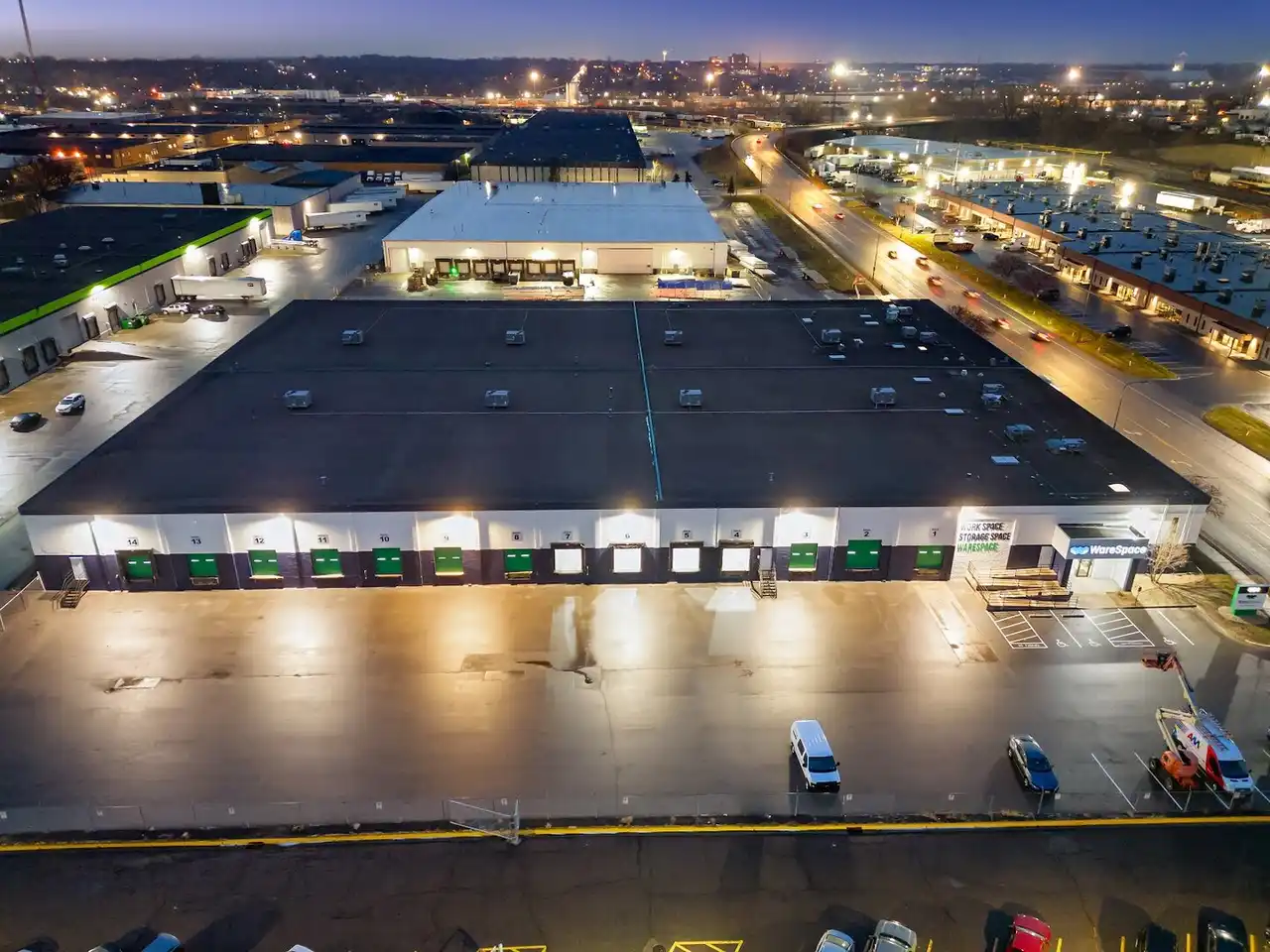
Denver’s industrial headlines in 2026 are about softness: rising vacancy, negative absorption, and a wave of big-box deliveries near the airport. But that story hides the part that matters most to a small business looking for space. The smallest, most useful units in the metro are some of the tightest, and almost nothing new is being built to relieve them.
Denver’s small-warehouse market at a glance
Across the Q1 2026 brokerage reports, Denver’s overall industrial vacancy landed between roughly 7.4% (Colliers) and 9.4% (CoStar), with Cushman & Wakefield at 7.7% and Lee & Associates at 9.2%. Net absorption was flat to negative and asking rents had softened year over year. On its face, a tenant’s market.
But the metro number blends two very different segments. The vacancy is concentrated in large, modern big-box buildings over 250,000 Sq Ft near Denver International Airport, where recent speculative deliveries pushed availability up. Strip those out and the small end of the market looks nothing like the headline.
Why small-bay space is the tight spot
Every major report that breaks Denver down by building size says the same thing: smaller is tighter.
| Segment | Q1 2026 vacancy | Source |
|---|---|---|
| Buildings under 100,000 Sq Ft | 5.7% | Cushman & Wakefield |
| Small-bay under 50,000 Sq Ft | mid-6% range | Lee & Associates, CoStar |
| Big-box over 250,000 Sq Ft | 8.3% | Cushman & Wakefield |
| Metro industrial overall | 7.4% to 9.4% | Colliers / CoStar |
The reason is supply. Denver’s construction pipeline is dominated by big-box product near the airport, while infill submarkets report little to no new small-bay development. The economics of new construction simply do not work for small units, so the buildings that small businesses actually need are not being replaced as fast as they are absorbed. Cushman & Wakefield noted that leasing for spaces under 250,000 Sq Ft ran nearly four times that of big-box space in the quarter, and small-bay space leased in about 5.5 months on average.
What it actually costs to lease in Denver
Flex asking rents across Denver averaged roughly $13 to $17 per Sq Ft NNN in Q1 2026 (LPC put metro flex at $16.91 NNN; Cushman & Wakefield at $13.19 NNN), with industrial closer to $10 to $12 NNN. In the Southeast submarket that covers the Denver Tech Center and Centennial, LPC pegged flex at about $14.31 and industrial at $11.35 per Sq Ft NNN.
Here is the catch most rent comparisons miss: those are triple-net (NNN) quotes. The headline number is just the base rent. On top of it you add CAM charges, property taxes, building insurance, and utilities, and you usually commit to a multi-year term on 5,000 Sq Ft or more. The real all-in cost is meaningfully higher than the sticker, and it is hard to predict year to year.
That is the gap WareSpace is built for. Instead of a base rent plus a stack of pass-through charges, a WareSpace unit is one flat price starting at $1,000/mo that already includes the loading dock, year-round HVAC, 24/7 access, and WiFi, on a short 6 to 12 month term. No NNN math, no CAM reconciliation, no surprise escalations. See current pricing or get an instant quote.
Where WareSpace fits: Park Hill and Centennial
WareSpace covers the Denver metro from two ends, so there is space near where you already work.
Centennial / Denver Tech Center sits at 360 Inverness Drive S. in Englewood, minutes from I-25 and C-470 and about seven minutes from Centennial Airport. It is leasing now and is built for South Metro storage, fulfillment, and light production serving Greenwood Village, Lone Tree, Highlands Ranch, and Parker. This is the heart of the Southeast submarket where market flex space asks around $14 per Sq Ft NNN before add-ons (LPC).
Park Hill, at 5150 Colorado Blvd in central Denver, is now open near I-70 and I-25, about ten minutes from downtown. It is positioned for businesses that need flexible warehouse space close to the urban core, including RiNo, Five Points, Central Park, and Aurora, where infill space is hardest to find and big-box construction does nothing to help.
Both buildings offer all-inclusive units from 200 to 2,000+ Sq Ft. Browse everything on the Denver locations hub or book a tour.
Who’s renting small warehouse space in Denver
The demand the brokers describe, small and mid-sized, locally focused, is exactly the WareSpace tenant base along the Front Range:
- E-commerce and fulfillment brands that need to store, pick, and pack without a 3PL contract
- Contractors and trades that need secure storage plus a place to stage crews and materials
- Light manufacturing and assembly operations too big for a garage, too small for a NNN lease
- Local distribution serving the Denver metro and the broader Front Range
This pattern holds across the country. For the national picture behind these local numbers, read The State of Micro-Bay Industrial Real Estate 2026.
Market figures in this report are drawn from publicly published Q1 2026 Denver industrial market reports by Cushman & Wakefield, Colliers, Lee & Associates, LPC, Matthews, and CoStar. WareSpace pricing reflects all-inclusive monthly rates starting at $1,000/mo and is not directly comparable to triple-net asking rents.


